Sunday, March 27, 2011

FROM A MIGRANT'S PERSPECTIVE: A glimpse into the life of a Migrant Student from Southern Sudan

(Note from the author: Approximately 2 million Southern Sudanese live in the Diaspora. Lual Peter Dau is one of them. In this interview, he gives some insights into what life in the Diaspora is like for a migrant student from Southern Sudan. And since this interview was conducted in March, the month in which we commemorated the International Women’s Day, I pegged some of the questions on the empowerment of women in Southern Sudan.)


-------------------

“Sanyu!”

Startled, I turn round to find Lual standing right behind me. In full view of everyone at the restaurant, he pulls me close to his chest and locks me in a tight embrace. He is a tall man! I can hear his heart beating against my right ear. It’s cold and windy outside; he is nice and warm. I allow myself to sink deeper into his embrace.

He suddenly pulls away.

“Come!”

It’s an order. You’ll know an order when you hear one; this is an order. I meekly follow in his footsteps, as he leads me up a narrow flight of stairs. He walks about one meter ahead of me. He is dressed in a crisply ironed long-sleeved white shirt that is lined with blue stripes. His well-fitting slightly faded blue jeans are held in place by a brown leather belt and his sharp-pointed black leather shoes are so well polished that I could swear I can see my reflection in them.

We are at an upscale restaurant in Nairobi’s city centre. Nairobi is the capital city of Kenya; a country that geographically lies to the south of Southern Sudan and metaphysically maintains a position of prominence in the heart of many Southern Sudanese. It is widely believed that were it not for the efforts that Kenya’s leaders placed in helping to broker peace between the rebels in Southern Sudan and The Sudan’s government forces in Northern Sudan, there is chance that the 20 year-old civil war would still be raging to this day. Well over 15,000 Southern Sudanese are said to be living in Kenya. Little wonder that the Southern Sudanese flag bears a startling resemblance to the Kenyan flag.

It has taken me two and a half months of persistent phone calls, text messages and emails to (finally) get this interview with Lual. The only thing that is more outstanding than the size of this man's shoes is his dazzling smile! This is a glimpse into the life of Lual Peter Dau; political activist, community mobilizer and chef extraordinaire:
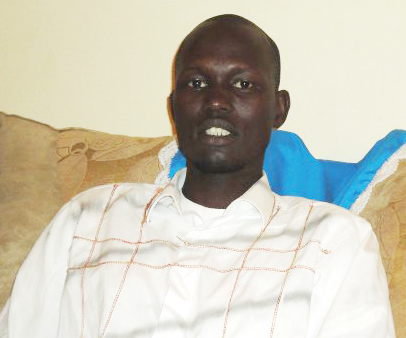
ABOVE: Lual Peter Dau: political actvist, community mobilizer and chef extraordinaire.


1. Tell us about yourself.

I am a Dinka man. (Note from the author: the Dinka, also refered to as the Jieng, is the largest ethnic group in Southern Sudan and they are mainly agro-pastoral people.) I come from a very big family in Southern Sudan. My father took for himself several wives. I was born to the sound of the drum beating to the rhythm of war. I left Sudan when I was very young, and I moved to live with some family members who had migrated to Uganda. (Note from the author: Uganda, found to the south of Southern Sudan, is a landlocked country located in the interlacustrine region of East Africa.) I studied in Uganda for most of my elementary education. When I completed my basic education, I worked for sometime in Southern Sudan with the Lion Commercial Bank. Thereafter I moved to Kenya to embark on my tertiary education at the United States International University. I am currently pursuing an undergraduate degree in International Business Administration.


2. Why did you leave The Sudan?

The primary push factor was the dilapidated social amenities back at home. No schools, no hospitals, no roads … tell me, would you want your child to grow up in such an environment? (Consternation fills his eyes.)

(His phone rings; the ringtone is a traditional Dinka folk song. “Come here, upstairs,” he says to the person on the other end of the line. As he talks on the phone, he asks me how my day was and simultaneously places an order for ‘very strong coffee’ with the waiter who is standing patiently at the right hand side of our table. I busy myself by staring at the huge plasma screen that is hanging above his head. Throughout our interview, his phone kept ringing. And throughout the interview, Southern Sudanese kept streaming to our table to say hi to him. And throughout the calls and the streams of people, I kept staring at the plasma screen.)


3. Take us through what a regular week in your diary would look like.

I am a fulltime student. That is why I am here in Kenya, and not back home in Southern Sudan. In fact, right now, I should be back home in Southern Sudan. From 9am to 7pm, Monday to Thursday, I am at the university. On Fridays, I clear all my assignments. Saturdays through to Sundays are the days that I set side for the activities that are organized by the Southern Sudanese students who live in Kenya. I use my phone to coordinate a lot of activities here in Nairobi, and in several other towns across Kenya. In fact, almost half of my monthly budget is allocated to my phone bills. I am always in touch with my fellow Southern Sudanese. And not just here in Kenya, but also in Uganda, in Australia, in Egypt, in USA … you can choose any country that you want. We are all over the world. And all of us are going back home!


4. This month (March), the world celebrated the International Women’s Day. Recently, Southern Sudanese voted resoundingly to cede from Northern Sudan. In relation to women’s rights, what do you think the immediate priorities for the new State should be?

In fact, these women are very important!

(In a show of great ferocity he cuts a blow across the air with his right hand.)

Let no one deceive you; in Southern Sudan we value our women greatly. If it was not for the support that we received from our women, we could not have succeeded in our fight for liberation. No, that is definite; we could not have succeeded! In addition to actively participating in the frontline, these women also provided our soldiers with food, medical supplies and substantial amounts of alcohol, amongst many other things. Let me tell you about the alcohol: this alcohol that they made for us was local brew. This brew helped to boost the morale of our soldiers as they went to the battle field to face the enemy. The alcohol helped to make us brave; it helped to make us fearless!

Now, to your question. The Government of Southern Sudan has introduced a quota system by which women are automatically granted 25% of representation in the army and all arms of civil service. I congratulate the government for this move, and encourage the government to keep going out of its way to empower our women and to build their capacity so that they can make a significant contribution to the advancement of our new nation. We need our women to take control of the new nation, in the same way that they were in control during the war; even though they may have been behind the scenes.


5. What are some of the challenges and opportunities that lie ahead for the women of Southern Sudan?

Alright please. In my culture, there are many wise sayings about the important roles that our women play in society.

(He pauses and frowns deeply, as though to squeeze thoughts from his brain. It seems to work! He launches into an avalanche of idioms in his native tongue – Dinka. I do not speak the tongue, but fear to interrupt and point this out, mostly because he leaves no room for interruption. I keep nodding my head, as I zealously note down what he says, syllable-for-syllable. Then I get lucky: a text message is delivered to his phone. He pauses to read the message. That’s all the two seconds that I needed. I jump on the question again: “What are some of the challenges and opportunities that lie ahead for the women of Southern Sudan?”)

Oh yes! Sorry about that. Well, as I said earlier the Government’s mandatory 25% representation system for women is definitely one of the opportunities that the women can take maximum advantage of. And of course, a major challenge will be for the women to make up for all the years lost in war and to catch up with the development rate of women in other countries across the world. And they must work hard to attain proper education. School is very important. We need well educated people to help us establish the foundation for our new nation.


6. You are actively involved in matters to do with the Southern Sudanese Students’ Association in Kenya (SSSAK). Tell us about that.

(Note from the author: In the upcoming SSAK elections, Lual intends to run for the position of Vice Chairperson.)

Okay, thank you. First of all, this is not the first time that I am involved in student associations. In high school, when I was in Uganda, I was part of the team of Southern Sudanese students who started a students’ association there. In that capacity, I served as the Secretary of Information. Here in Kenya, the main objective of establishing SSSAK (the Southern Sudanese Students’ Association of Kenya) was to promote the co-existence of the Southern Sudanese students in tertiary institutions of learning here in Kenya. We specifically target students in high schools and universities. We have a following of about 5,000 students spread across approximately 17 universities and 83 colleges. My involvement in these student associations stems from my deeply held conviction that Southern Sudanese need to care for each other and support each other, and more so when they are away from home. Those that have stand in the gap to support those that do not have. Some Southern Sudanese students in the Diaspora need much more assistance than others. Some may not have money for medical attention, for food, or even for school fees. Then the ones that have support the ones that do not have. We share all our problems. That is how Southern Sudanese people are. It is in our nature. The Students’ Association here in Kenya is recognized by the Government of Southern Sudan. In fact, every year, they disburse funds to us which we give to our members as educational grants. There is also an Educational Attaché at the Southern Sudanese embassy here in Kenya who we report to. We are also recognized by the Government of Kenya.


7. What are some of the tangible things that the Southern Sudanese Students’ Association in Kenya has done to address some of the challenges that your people are facing back at home?

In my opinion, perhaps the most important thing that we have done is to coordinate the transfer of manpower and skills from Kenya to Southern Sudan. We have organized for many of our members to go back home as volunteers in order to build the capacity of the people in our growing nation. Nowadays, we do not consider just going to school as progress. You need to show us what you have learned by going to that school! Okay, you went to the university and studied Hotel and Restaurant Management. Good. Now can you come home to Southern Sudan and teach our people how to start up and run hotels? Because if you can not, then we have no need for you. You need to show us the results of what has been keeping you so busy. Show us!


8. In comparison to the friends that you left in Southern Sudan, what would you say are some of the advantages that you have enjoyed as a migrant student in a foreign land?

There are no educational facilities back at home that you could compare to what we have at our disposal here in Kenya. For me, this is the greatest advantage that students in the Diaspora have. In addition, for a business man like myself, I have had an opportunity to meet with many prospective investors from all over the world because there are many more different nationalities of people found here in Kenya in comparison to the number that you would find in Southern Sudan. I have also had the opportunity to make friends with people that I may have never met if I had stayed at home and not travelled to another country.


9. What are some of the challenges that you experience as a migrant student in a foreign land?

Discrimination: It takes time to settle in a foreign land and to be fully accepted as being deserving of all the privileges and opportunities that are available to the natives of that country. And also, this foreign language is a big, big, big problem. And then we also have the problem of food. Tell me, if a Dinka man comes to your house and you give him githeri to eat, do you really think that he can be comfortable? (Note from the author: Githeri is a traditional delicacy in Kenya. Beans and maize are boiled together, and then fried in tomatoes and onions to make this meal. Sometimes, meat and irish potatoes could also be included.)


10. If you could meet with anyone in the world, who would you want to meet with, and why?

(He locks me in his gaze.)

Former President of Kenya, Daniel Toroitich arap Moi. Now, a person like him, seeing him would be a great honor! In fact, he has done so much for my people. When we were still fighting, he was always travelling to Southern Sudan, and telling our leaders, don’t do like this, do like this, and don’t look behind! He is like my father, and not just my father alone, but the father of all Southern Sudanese. Seeing a man doing such things for us and he is not even a Southern Sudanese, how do you think it makes me feel?!! He has really worked hard to promote development in Southern Sudan. I respect him a lot.


11. What are your goals for the next year and beyond?

(He deflects the question from himself and instead focuses it on the aspirations that he holds for SSSAK – the Southern Sudanese Students’ Association of Kenya.)

Aaaaah, well. We want to give SSSAK more visibility. We want to be better understood and more popular. We shall also carry out several mobile sensitization campaigns that will focus on various issues ranging from prevention of the spread of HIV/AIDS to promoting a culture of environmental consciousness. We also intend to establish a well-structured loaning system for our members who need assistance paying for their education.


12. Parting shot: A message to the Southern Sudanese women back at home.

(My pen fails, and I panic because it dawns on me that I have no other! I curse under my breathe: "Why wasn’t I warned about this in Journalism school??!" He notices my frantic efforts to resuscitate the pen and swings his sleek gold-coated pen at me. I am embarrassed. I apologize profusely for the hitch.)

You know, women are the backbone of our country – Southern Sudan. Their contribution during the war is what made us to go through. And in the same way, their contribution to our current government is what will make our new country to go through. In fact, for example, right now, Maama Rebecca, the wife of the late Dr. John Garang, is the one who is running affairs in our government. The women should take their rightful position as the ones that will educate our men about good leadership and effective development. Do not wait to be given this position; it is already rightfully yours. Just take it. And also, please, if you have not yet attained proper education, go back to school and read. Get education; develop your skills, so that you can be better leaders.


13. Is there anything else that you feel would be important for us to take note of?

My encouragement to the youth in the Diaspora: I encourage unity amongst ourselves. Let us maintain good leadership, and also put in a lot of effort towards attaining quality education. We are privileged to be in school. Let us take maximum advantage of this opportunity, put a lot of commitment, and go back home and show the people the difference that quality education can make. We need to show them tangible results of this education that we keep telling them is so important. And also, most important of all, let us focus on the development of our new nation – Southern Sudan.

For the youth at home: You must cooperate with the government. If the government does not have your support, it will not be very effective at the grassroots. We must use our networks across the ten states to support the government’s efforts politically, socially and economically. Why? Because we command a great majority and we are very influential. If we do not support the government, they will not achieve full success in Southern Sudan. And let us not forget our culture. Who we are; who our people are; where we have come from; and where we intend to go. A people without their culture are a lost people.


(This last question is not part of what I had planned to ask him, but I am persuaded to because Lual’s reputation of being an outstanding chef precedes him by far!)

14. Who taught you to cook as well as you do?

No, those are simple things. It would be much better for us to discuss politics. (He smiles.) I watched my mother cooking when I was a young boy and after I left home and I went to live in another country, I found strange food that you can’t give to a serious Dinka man. So I taught myself how to cook, just the way that I used to see my mother cooking for us. Why should I starve when I cook for myself? You know, on average, 10 to 15 people come to stay with me in my apartment, week-in and week-out. And these are big men, big Southern Sudanese men. Big like me, and some are even bigger than me! (He chuckles.) Now, you tell me, if I do not cook for them good food, do you think that they will ever come back to visit me? (He looks at me intently, and I am not sure whether to respond or not. I choose not to respond.) No, they will not! And if they go and never come back, I will miss out on blessings. When you have visitors coming to your house, those are automatic blessings. Wouldn’t you want these blessings?

(At the end of the interview, we walk out of the restaurant in much the same fashion that we walked in. He walks ahead of me, all the while maintaining a distance of about one meter. I meekly maintain my position behind him. And yes, his phone keeps ringing.)

End//


Theme (s): Migration, Development, Education, Women’s Rights


The author is a humanitarian analyst and she writes on migration. Email her on: msanyu@yahoo.com

Wednesday, March 16, 2011

IN HONOR OF THE 2011 INTERNATIONAL WOMEN’S DAY: Six (6) quick facts that draw a link between Migration and Women

(Note from the Author: The photos I have used in this piece are some of the ones that I took at a celebration that was held in Nairobi, Kenya to mark the 2011 International Women’s Day. This year’s theme was: “Equal access to education, training and science and technology: Pathway to decent work for women”.)


Above: LABOUR MIGRATION: Women constitute around 60–80 percent of the export manufacturing workforce in the developing world. (courtesy, World Bank)


Above: FORCED MIGRATION (Refugees): Together, women and children constitute almost 70 percent of those under the care of the United Nations High Commissioner for Refugees today. (courtesy, UNHCR)


Above: ECONOMIC MIGRATION: Female migrants are increasingly part of flows of migrant workers, moving on their own to become the principal wage earners for their families. (courtesy, Division for the Advancement of Women Department of Economic and Social Affairs United Nations)


Above: LABOUR MIGRATION: It is estimated that if women’s paid employment rates were raised to the same level as men’s, America’s GDP would be 9 percent higher; the euro-zone’s would be 13 percent higher, and Japan’s would be boosted by 16 percent. (courtesy, UNIFEM)


Above: MIGRANTS WITH DISABILITIES: Australia’s migration policy promotes the discrimination of women (men and children) with disabilities owing to what is perceived as the “financial burden” of taking care of them. (courtesy, ISIS International)


Above: ROUTINE MIGRATION: If the average distance to the moon is 394,400 km, South African women together walk the equivalent of a trip to the moon and back 16 times a day to supply their households with water. (courtesy, UNIFEM)


The author is a humanitarian analyst and she writes on migration. Email her on: msanyu@yahoo.com

End//

Friday, March 11, 2011

UGANDA: Ex-combatants struggle to reintegrate in Northern Uganda

by Mary-Sanyu Osire

GULU, 11 March 2011 (VoM) – Behind closed doors, Northern Uganda is referred to as “the place that God forgot”. Over the past two decades, a rebel movement, The Lord’s Resistance Army (LRA), led by Joseph Kony, has unleashed brutal violence on the local population. Under the command of the rebels, mother has been forced against daughter, nephew against uncle, and neighbour against neighbour. Untold thousands of civilians have been raped, felled by machetes and claimed by bullets.

In addition, approximately two million people – roughly 80% of the total population of Northern Uganda – have been displaced and herded into Internally Displaced Persons (IDP) camps. Upon captivity, young boys have been forcefully indoctrinated and turned into child soldiers, and young girls into sex objects for the warlords. The twenty-year insurgency that started in 1986 has been characterised in international humanitarian circles as “one of the world’s most forgotten crises.”

Today, the war that started in Uganda has spilled over to neighbouring countries: Southern Sudan, the Central African Republic and the Democratic Republic of Congo. Joseph Kony is still on the run, but a semblance of calm has returned to Northern Uganda.

In a bid to foster peace, the Government of Uganda has on several occasions offered amnesty to the rebels. In exchange for laying their arms down, the ex-combatants are being given full pardon for all crimes committed and have been allowed to come back home. This process, known as Disarmament, Demobilization and Reintegration (DDR) has seen many rebels return home. In some circles, this acronym is extended to include another “R” that stands for an additional component known as ‘Rehabilitation’: DDRR.

Disarmament, Demobilization and Reintegration (DDR) in Africa

According to Ernest Harsch of Africa Renewal, one of the leading analytical magazines on the socio-economic challenges facing Africa: “DDR programs across Africa show that reintegration is a complex and long-term process. It is fraught with difficulties and depends on the success of wider efforts at economic recovery and political reconciliation.”

The process of Disarmament, Demobilization and Reintegration is not a new phenomenon in Africa. Liberia, Rwanda, Sierra Leone, the Democratic Republic of the Congo, Zimbabwe, Burundi, the Central African Republic, and Angola are some of the countries that have rolled out DDR programs similar to the one being run in Northern Uganda. Each of their programs was met with some challenges and Uganda’s DDR program is also experiencing bottlenecks.

The scramble for limited resources

Following the Government’s amnesty, the combatants in Northern Uganda have been returning home in droves. As the ex-combatants reintegrate into society, they continue to face several psycho-social and economic challenges that include stigmatisation, heavy reliance on food aid, endemic poverty, and ongoing trauma related to the war. According to a report commissioned by the Justice and Reconciliation Project, these challenges are often made by worse by limited economic opportunities and low standards of education.

The return of the ex-combatants is coinciding with the return of thousands of displaced Ugandans from crowded IDP camps where they have been living for the last two decades. The internally displaced persons started moving back home in September 2007 after the Ugandan government began closing down camps. This mass influx of returnees has served to exacerbate the smooth reintegration of the ex-combatants, who are now being forced to join in squandering for the meager resources that are available to the local population. One such meager resource is land.

Location: Northern Uganda. This boy is one of the (estd.) 30,000 child soldiers that was forcibly recruited into Joseph Kony's rebel movement. PHOTO CREDIT/invisiblechildren.com

In a recent article published by IRIN, a news agency that provides in-depth analysis of humanitarian developments around the world, it was reported that owing to the large number of returnees, disputes over land in Northern Uganda are escalating. An explosive situation is in the offing with clan turning against clan in a frantic effort to mark their territory. Charles Obwoya, a local resident who was attacked in December last year by members of a rival clan asserted to IRIN: “Here you have to be armed with a spear or machetes because you can’t predict what can happen at any moment.”

Situations like this can in many instances work against the success of a DDR program. Massimo Fusato, a researcher at the University of Colorado and the author of Disarmament, Demobilization and Reintegration of Ex-Combatants says, “After ex-combatants have been demobilized, their effective and sustainable reintegration into civilian life is necessary to prevent a new escalation of the conflict. In the short term, ex-combatants who do not find peaceful ways of making a living are likely to return to conflict. In the longer term, disaffected veterans can play an important role in destabilizing the social order and polarizing the political debate, becoming easy targets of populist, reactionary, and extremist movements.”

Not ‘DD’ plus ‘R’

According to Mr. Francis Kai-Kai, former head of Sierra Leone’s national DDR committee, “DDR should not just be ‘DD plus R’ with reintegration as an afterthought, but a continuous, integrated process. You don’t just focus on men and weapons, but on their futures as well.”

END//
----------------------------

Region: Africa, East Africa, Uganda
Theme(s): Migration, DDR(R), Post-conflict reconstruction, IDPs


The author is a humanitarian analyst and she writes on migration. Email her on: msanyu@yahoo.com

Monday, February 28, 2011

SOMALIA: Thousands displaced as nature turns its wrath on local population

by Mary-Sanyu Osire

The drought in Central and Southern Somalia continues to hit hard on the local population. This recurrent situation, compounded by Somalia’s protracted inter-clan fighting, has forced many people to flee from their homes in search of food and water. In recent days, thousands have crossed into neighboring countries.

Implication on neighboring States

Kenya lies to the South West of Somalia. Because it is one of only three neighboring countries, it has had to bear the brunt of accommodating the thousands of fleeing migrants.

UN’s Emergency Relief Coordinator, Valerie Amos, at a press conference this week: “Even as we speak, there are significant urban population movements from [Somalia’s] Hiran and Middle Shabelle regions to Kenya. The new waves of refugees from urban areas in central and southern Somalia will join the more than 430,000 Somalis who have previously fled to Kenya.”

The refugee camps in Kenya are swelling in numbers. This January alone, the country received the largest number of migrants that it has received in a single month over a period of more than two years: 8,000 women, men and children.

According to the latest humanitarian reports, Ethiopia, Somalia’s neighbor to the West, is facing the same exigencies that Kenya is struggling with. There are around 40,000 registered refugees in the Dolo Ado camp (Ethiopia).

Location: North Eastern Kenya, about 100km from the Kenya-Somalia border. A displaced Somali family awaits medical attention at a refugee camp in Dadaab. PHOTO credit/DoctorsWithoutBorders.com

Understanding the situation

UNHCR reports that over the last 20 years, drought and famine have continued to have a devastating effect on the Somalis. Over two million people in Somalia are said to be in need of humanitarian aid because of the ravaging drought and mounting violence.

According to media reports, a recent study conducted by US scientists warned that food crises in the region can only get worse, putting an estimated 17.5 million people at the risk of hunger in Somalia, Ethiopia and Kenya. The study titled: “More Frequent Drought Likely in Eastern Africa,” blamed the famine on low agricultural development and rapid population growth. It said the increased frequency of drought in Eastern Africa was also due to rising global temperatures.

In a recent interview with IRIN news, a Somali woman who has been displaced by these pressures summed it up this way: “Everything seems to be against us.”


END//


Region: Africa, Horn of Africa, Somalia
Theme(s): Migration, Climate change, Refugees, Relief work

The author is a humanitarian analyst and she writes on migration. Email her on: msanyu@yahoo.com

Wednesday, February 23, 2011

POEMS FROM A MIGRANT’S DIARY – Ma Chère Italie

This poem is written in French and in English. It is dedicated to the five asylum seekers who lost their lives last week after Italian coastguards are reported to have deliberately rammed into their boat, causing it to split into half. The asylum-seekers were crossing from Tunisia to Egypt. According to one of the survivors, the boat was carrying 120 passengers; 85 people were saved, five died and 30 are still missing. In recent weeks, more than 5,000 asylum seekers from Tunisia have made their way to Italy. Many have lost their lives along the way. This influx of asylum seekers comes against the backdrop of growing civil unrest in Tunisia.

Ma Chère Italie
by Mary-Sanyu Osire

Ma Chère Italie,

Je n’aime pas nager,
Mais je vais nager.

Et je vais marcher;
Et je vais courir;
Et je vais ramper.

Jusqu'à chez toi!

----------------------------------

My Dear Italy
by Mary-Sanyu Osire

My Dear Italy,

I do not like to swim,
But I am going to swim.

And I am going to walk;
And I am going to run;
And I am going to crawl.

Until I get to you!

----------------------------------

(The author is a humanitarian analyst and she writes on migration. Email her on: msanyu@yahoo.com)

Sunday, February 20, 2011

WEEKLY HUMANITARIAN BULLETIN: Migration Concerns in Kenya (14 – 18 February 2011)

by Mary-Sanyu Osire

This is a technical document, and in order to derive maximum value from its content, it may require the reader to have some programmatic understanding of migration issues.


WEEKLY HUMANITARIAN BULLETIN
Migration Concerns in Kenya (Africa, East Africa)
14-18 February 2011


>> KEY OVERALL DEVELOPMENTS

1) Forced Migration: Climate Change Refugees: Cross-border and internal movement of persons from drought-struck regions

In order to cope with the drought that is ravaging North Eastern Kenya, some pastoralist communities from the region crossed into Uganda with their cattle, in search of pastures and water. But their visit was short-lived after there was cholera outbreak in Uganda, and they were forced to return. This community represents Kenya’s latest Climate Change refugees. According to media reports, water pans have dried up and many boreholes are breaking down due to overuse. Several schools could be closed – it is reported that 14,000 students may drop out of school if the Government does not beef up its school feeding programs in the region. The Government of Kenya is involved in some drought mitigation activities, which include supply of water. It has also deployed a rapid response team to the area that will repair broken down boreholes and other water projects. Meanwhile, in Turkana, one person has been killed and another injured in a clash between Kenyan herders and cattle rustlers from Uganda.

IMPACT ON PROGRAMMING: In order to mitigate the impact of climate change on the pastoralist communities in North Eastern Kenya, there is an urgent need for climate change adaptation projects that will help the communities invest in alternate sources of livelihood. In addition, inter-state programs could be initiated that are aimed at facilitating the cross-border mobility of the pastoralists, and ensuring the security of the communities as they migrate. Owing to the increasing pressure on land and resources that the migrants impose on the communities that they move to, peace building programs should also be tailored into the projects.

2) Forced Migration: IDPs agitate for permanent housing

At the beginning of the month, the Government of Kenya reported that in order to pave way for the Internally Displaced Persons (IDP) from the 2007/2008 post-election violence to move into the 1,630 houses that it is constructing, the camps in the North Rift would be demolished by the end of this month (February). This week, some IDPs from Alko camp on the Nakuru-Eldoret highway led a mass demonstration to protest what they termed as “negligence” by the government and starvation in the camps. In other news, amidst accusations of the Government favouring certain communities in the Teldet Forest resettlement program, the Government has reported that it will buy land to resettle the 382 families in Teldet Camp. Thereafter, it will embark on the same program for the 105 displaced families in Patakwa. The families were evicted from Teldet Camp three years ago.

IMPACT ON PROGRAMMING: Programming geared towards the IDPs should focus on providing logistical support, psychosocial support, and working with the Government to ensure effective reintegration and the creation of an environment that would support long-term peace building and reconciliation efforts.

3) Regulating migration/Mixed migration: Human smuggling: Number of irregular migrants on the rise

This week, the arrest of 41 illegal migrants of Somali descent and 8 illegal migrants of Ethiopian descent served to fuel concerns about the growing of number of irregular migrants in Kenya.

IMPACT ON PROGRAMMING: Projects aimed at capacity building for migration management should continue to enhance the capacity of migration officers to regulate cross-border movement along the porous Kenya-Somalia border. The country of source should also be targeted for counter-human trafficking awareness campaigns.

Map credit/Google Images

4) Regulating migration: Capacity building in migration management: Piracy off the coast of Kenya’s shores

Media reports indicated that East Africa anti-piracy agents will be trained by Interpol to improve their forensic and investigative capacity in a new effort to curb cases of piracy in the Indian Ocean. A gap analysis conducted by Interpol identified three critical development needs in East Africa’s maritime field: Forensic facilities; Criminal investigations and Analytical capabilities.

IMPACT ON PROGRAMMING: This intervention comes at a time when Somali pirates have been travelling southwards of the Indian Ocean and towards the Gulf of Oman because of the heavy presence of international warships patrolling the Gulf of Aden. Programming should focus on training Somali youth on commercial skills that would allow for alternate means of livelihood. Furthermore, programs should also focus on building the capacity of East Africa’s anti-piracy agents to fight the piracy vice.


5) Migration and development: Return of qualified nationals: Most Kenyans in UK ‘want to come home’

Last week, Kenyans in the Diaspora expressed their interest in joining the race for positions in the next General Election. This week, the findings of a survey conducted by the Government of Kenya’s Ministry of Labour and the International Organization for Migration (Kenya country office) revealed that 80% of Kenyans residing in the UK want to return home permanently. In other news, a Labour Migration Unit that has been opened in the Ministry of Labour. The Unit was opened because of the need to protect Kenyans travelling, working and living abroad.

IMPACT ON PROGRAMMING: Programming should focus on encouraging the return of qualified nationals and helping them to reintegrate once they return home. The relevant arms of the Government should be thoroughly trained on managing returnee data collection and analysis. Furthermore, the returnees who require marketable skills training should be taken through the training in order to enhance the success of the reintegration program. Minority returnees (like the disabled) should have specific programs tailored to meet their unique needs.


>> RESPONSE PRIORITIES

The response priorities at this point in time cover: i) Climate Change adaptation for pastoralist communities in Kenya; ii) Controlling of human smuggling; ii) Resettlement of the post-election violence IDPs; iv) Piracy off the coast of the Indian Ocean and in the Gulf of Aden; v) the Return of qualified nationals.

Suggested interventions include:

Climate Change adaptation for pastoralist communities in Kenya: Rehabilitation of strategic boreholes; Supporting pastoralists to purchase camels because they survive much better in arid conditions than cattle do; Mass veterinary treatment/vaccination programs because weakened livestock are much more susceptible to disease; Fodder production and distribution; Scaling up food aid and nutrition intervention areas, as appropriate; Cash-for-money projects in key affected areas; Facilitating the cross-border mobility of the pastoralists.

Controlling of human smuggling: Anti-human smuggling awareness campaigns; strengthening border controls; Addressing the root causes of human smuggling amongst the community from the source country.

Resettlement of the post-election violence IDPs: Working hand-in-hand with the Government in order to provide permanent shelter; Long-term peace building and reintegration programs; Psycho social support; Offer livelihood opportunities; Logistical support.

Piracy off the coast of the Indian Ocean and in the Gulf of Aden: Strengthened capacity for the region’s anti-piracy agents; Alternative means of livelihood for Somali youth in order to deter them from engaging in piracy.

The Return of qualified nationals: Addressing the causes of brain drain; Strengthening the capacity of the recently established labour Migration Unit within Kenya’s Ministry of Labour; Designing attractive reintegration packages for emigrants; Linking nationals in the Diaspora to opportunities at home (including opportunities to give back to the society, opportunities for investment, etc.).


>> ANTICIPATED CHALLENGES

Climate Change adaptation for pastoralist communities in Kenya: An increase in resource-based conflict owing to the pressure that the nomads exert on the communities that host them; Increased displacement due to food insecurity may occur.

Controlling of human smuggling: Porous borders owing to limited security personnel; Migration officers’ capacity to respond to such incidents; Limited access to the most-at-risk communities in the country of source; Migration routes keep changing; It is a very ad hoc activity that is hard to anticipate; Corrupt elements at the border points who collude with smugglers.

Resettlement of the post-election violence IDPs: Highly political and sensational nature of the subject of the post-election IDPs; Limited ability to determine the genuine IDPs from the people that are just taking advantage of the situation.

Piracy off the coast of the Indian Ocean and in the Gulf of Aden: Inadequate infrastructure amongst Kenya’s anti-piracy agents; Limited access to the most-at-risk communities in the country of source.

The Return of qualified nationals: The nationals in the Diaspora have little faith in the Government’s capacity to deliver on basic social amenities.

END//


The author is a humanitarian analyst and she writes on migration. Email her on: msanyu@yahoo.com

Saturday, February 12, 2011

POEMS FROM A MIGRANT’S DIARY – Qui étés-vous?

This poem is written in French and in English. It is dedicated to young migrants who are forced to take up new ways and form new identities in order to keep from antagonizing their host communities. They struggle daily to make sense of the socio-cultural pressures that engulf them in their new found homes.

(Ce poème est d’un garçon qui s’appelle Mohamed. Il immigre en autre pays avec ses parents. Il vient de Djibouti.)

Qui étés-vous?
by Mary-Sanyu Osire

Je ne sais pas.

À Djibouti, je m’appelle Mohamed.
Ici, je m’appelle Moses.

À Djibouti, je vais à la mosquée.
Ici, je vais à l’église.

À Djibouti, j’ai beaucoup d’amis.
Ici, je n’ai d’amis.

Qui je suis?
Moi, je ne sais pas.
Quand vous me regardez,
Que regardez-vous ?

------------------------------

(This poem is about a boy called Mohamed. He migrated to another country with his parents. He is from Djibouti.)

Who are you?
by Mary-Sanyu Osire

I do not know.

In Djibouti, I am called Mohamed.
Here, I am called Moses.

In Djibouti, I go the mosque.
Here, I go to the church.

In Djibouti, I have many friends.
Here, I have no friends.

Who am I?
I do not know.
When you look at me,
Who do you see?

------------------------------

The author is a humanitarian analyst and she writes on migration. Email her on: msanyu@yahoo.com